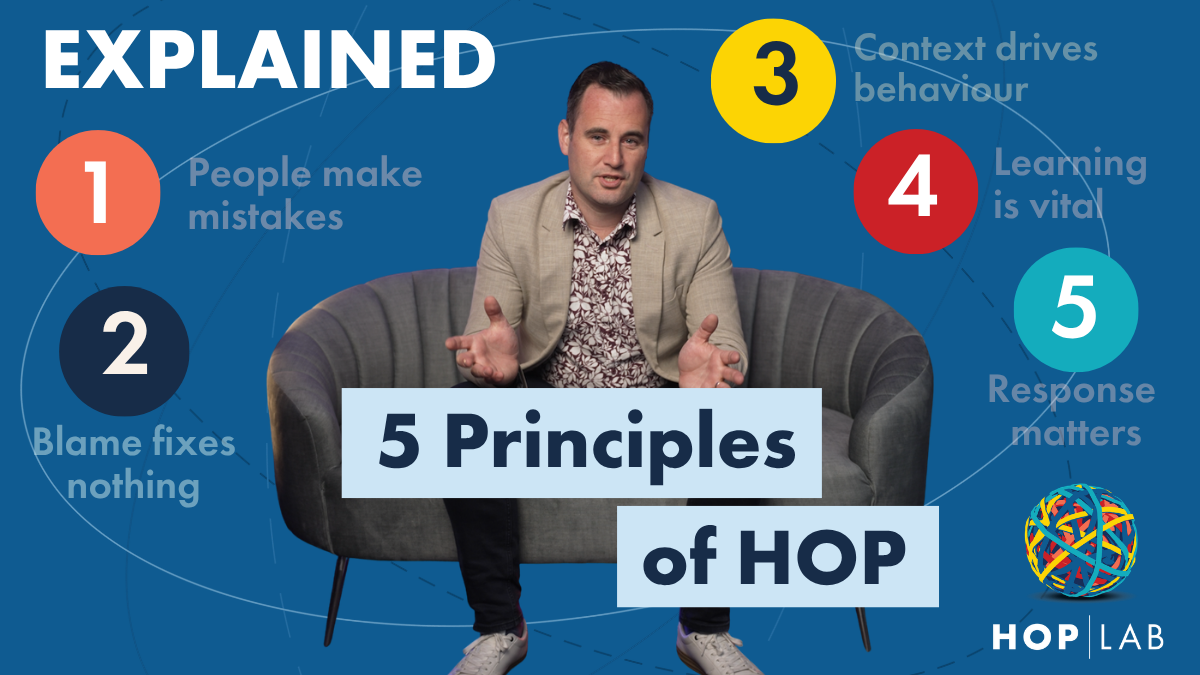
HOP has really become synonymous with the 5 principles of human and organisational performance.
And while these principles, on the face of it, are really quite simple, they contain within them a lot of other ideas and concepts which can be a little bit more challenging.
But on the face of it, they’re principles that everyone can understand and potentially apply in their workplace.
Whether it's unintentional, whether it's it's an error, something I didn't intend to do, or maybe it's something intentional, but I didn't intend a bad outcome to happen.
It's part of being human. It's part of being fallible. We will make mistakes. The more interesting thing is not that we all make mistakes.
It's more around what led up to the mistake. What led to or what triggered that particular action or inaction?
This is essentially an acknowledgment that if an organisation is more interested in blame, they’re not going to get to the context and the conditions and the things that led up to the mistake in the first place.
Blame shuts down learning. So blame in itself is not helpful. This is not a utopian view of the world.
Of course, there will be times where the consequences and discipline is necessary, but that should not be our first go to response when something bad has happened.
This is an acknowledgment that as much as we've been interested in behaviour in the past in safety, behaviour doesn't exist in a vacuum, and it's not something that belongs exclusively just to the person who has demonstrated that behaviour.
It might be seen as a bad choice or an unsafe behavior or an at risk behaviour.
Well, that's one way of categorising the behaviour but rather than categorising it, we need to be more interested in what influenced it, what shaped that behaviour.
So HOP is really calling on us as leaders, as safety professionals, to be more interested in context.
What is influencing, shaping, decision making every day?
And there's a vast array of things that could be at play, and it's that we need to explore.
How do we do that? Well, that's where the fourth principle of HOP comes in - Learning is Vital.
Again, there are lots of different types of learning an organisation can do, but the specific type of learning we're talking about in HOP is really getting into understanding the complexities and the nuances of everyday work.
Oftentimes this is called ‘blue line’ or ‘work as done’.
And this sometimes can be overlooked either willfully or intentionally, but it's exploring the everyday intricacies of work.
The adaptions that people make every day, which more often than not, actually lead to success, but sometimes they can lead to bad outcomes.
So we need to learn work with the people who do the work to learn about work so we can learn and improve.
If we want to do any of those previous steps well, we have to respond well that's as leaders, as safety people and even other people, colleagues and peers other people involved in an event.
How we respond defines whether we learn and improve, or if people start running for the hills and taking cover.
So response really matters, allowing time for real deep learning to happen, to try and shelter people from the pressure that comes around an event, setting people up to be able to tell the truth, and for us to be able to work together, to collaborate, to improve work.